
Alive This Time Next Year
Never Forgive You: Chapter 4

Note: Since this is a holiday weekend in the US, this will be the only post this weekend.
Summer, 2013
“Wait!” Noelle spun around and looked straight at Ruthie. “Did I give you butt cancer?”
Ruthie lay across the leather recliner, legs over one armrest, head thrown back, laughing at Noelle’s sudden worry. “No, that didn’t give me rectal cancer,” she guffawed.
“But pencils have lead in them,” Noelle had a worried look as she said it.
“Actually, it’s graphite,” Ruthie and I said simultaneously.
“I don’t know this story,” I said from my spot on the sofa. I’d been half reading, half people-watching family members on the other side of the full windows. A few of the guys were using the rope swing that Dad and the guys secured from a huge tree next to the deck. They’d climb the railing, slide the saucer between their legs and launch out over the lake, letting go as they arced high over the water. A few younger kids were cheering them; others were inside, playing games at the long dining table. One of us was prepping dinner in the kitchen. This time last year, Andrew and Ruthie had shown up considerably thinner. He’d step in place during evening conversations and fasted at least twice that week. Ruthie swore she wasn’t doing anything, though she was cooking healthier for Andrew’s sake. Her weight loss portended something. Only she’d had an inkling of what.

“You’ve never heard about the pencil stab?” I hadn’t because they were in high school when it happened. Married, living in another state, David and I must have missed visiting while Ruthie had a couple of stitches in one butt cheek.
“What happened?” I asked. Noelle and Ruthie tagtold me about their tiff, which started during a discussion about one of their assigned reads. By then, Mom used a different curriculum for homeschooling, not the reading of textbooks and answering questions at the end of the chapter.
Noelle said she felt stupid—her own fault because she hadn’t read whatever book Mom assigned for whichever class. They couldn’t remember which class or book all these years later, only that they’d been in the living room and Ruthie was out arguing with Noelle on some point. Noelle stood, Ruthie stood. Tempers flared. Noelle said she remembered shoving Ruthie back a little.
“I must have left my pencil, and it slipped between the cushions. When I plopped back on the couch, it stuck.” She had to ride, face down on a van bench, to the hospital. Noelle and Ruthie were howling now, recalling the absurdity of it all.
Just as Dad walked in, someone—Ruthie, I think—suggested Cards Against Humanity after the kids went to bed. David and I had cringed our way through a couple of rounds, including one with Ruthie and Andrew a couple of years earlier. Dad asked the premise, Ruthie explained, and I promised we’d keep it pretty tame. I’d already scheduled hard talks that week, one with my parents and one with Ruthie and Andrew. Ruthie and I agreed that she’d feel better if Andrew and the family knew her end-of-life wishes. And, because our parents were in their fifties, I asked if they, or anyone else, wanted to have “the talk.” All of my other siblings and their spouses avoided eye contact when I brought it up early in the week.
The whole week felt awkward. The talk with Andrew and Ruthie went fast. I explained the documents they should review: medical power of attorney, complexities for DNRs at her age, plans for the kids, should something happen to both of them. Then, I broached burial options. Ruthie and I had talked about low-cost burials.
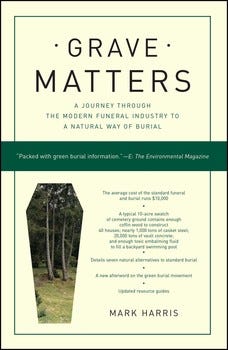
The average cost of a funeral is almost as much as a wedding, I’d told her. Since I’d switched my MFA thesis to dying, death, and burial, I’d read through the first of nearly thirty books, including Jessica Mitford’s The American Way of Death, Revisited and Mark Harris’ Grave Matters, from which I drew the number of the common American funeral: ten grand. I outlined the costs for cremation: three to five grand. But, I told them both, for Andrew’s sake, because Ruthie had already considered asking if she could be buried on her in-laws’ farm, that Ruthie had options for green burial.
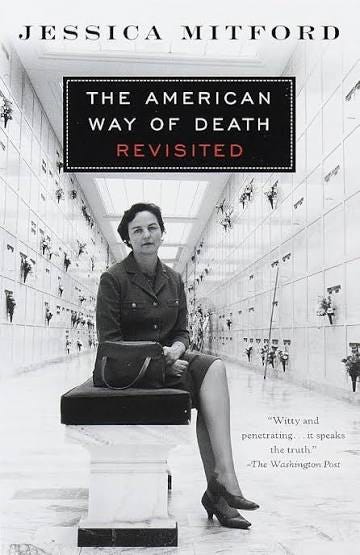
Our congregation, along with another, had space for a natural burial, I told them. Andrew wanted me to explain.
“Traditional burial, or what we think is normal in the US, is not really traditional. In fact, it’s somewhat new. Embalming only became common during the Civil War, when the North was trying to send dead troops home to their families. It took off after two doctors, Charles Brown and Henry Cattell, reinjected embalming chemicals into Abraham Lincoln’s body to pink it up as it toured over one thousand six hundred miles in thirteen days before being shoveled six feet under.
Lincoln’s train tour moved the market on embalming. Within thirty years, embalming went from luxury to staple. Faster than the fifty years for most households to own a car, and slower than fourteen years for most homes to have a television, both of which hit that number in the 1960s, the same decade steel caskets overtook wooden ones.
I re-explained, for Andrew’s sake, what I’d told Ruthie about observant Jews, Muslims, and Christians in “the old countries” like Greece do. For the cost of a wood box, or maybe even something cheaper—I planned on using a shroud—we could bury her. Of course, Indiana was the eighth most regulated state and required a licensed funeral director to observe the interment.
“Probably because we have a huge casket company and all its lobbying power. Funny enough, one of my college besties’ dad was president of the company when she was in high school. Not now, though. Some mega corporation bought it out.” Like healthcare, retail, and veterinary industries, private equity would poach the company and the rest of the funeral industry within a few years after Ruthie’s death.
Poet and funeral director David Lynch bemoaned the consolidation of the industry, pushing family-owned funeral homes out of business. I told Andrew and Ruthie, “He’s not that far from you, but I’m not sure if he’s for green burials—though he does go stay with his family in rural Ireland, where they still don’t have toilets in their cottages. In one of his books, he describes digging a hole to do his business.” I thought this amusing, and maybe promising. “I can also reach out to our cousin’s husband to see if he’d help. I don’t know if you’ll need a funeral director, but he may know. Of course, that’s in Lancaster, Pennsylvania, not Michigan.”
Ruthie liked that idea. Maybe he’d know if she could be buried in Pennsylvania or Maryland, she wondered, Lancaster only being an hour from the state line. Out loud, I said, “I’ll put emailing him on my things to do.” Inside, dread filled me. Green burial didn’t jive with profit margins, and family-owned funeral homes operated with the smallest ones. Something within niggled at me. Don’t push all this too much right now. Ruthie’s going to beat this. This is the first of many conversations.
“No need to nail it all down this week. We can talk again.” Ruthie and I would revisit it off and on for the next few years. Andrew? He became a black box. If I needed to believe Ruthie would live for a few more decades, Andrew needed to see her at their kids’ graduations.
Talking with them was a stress test. By the time we finished, my parents felt more like the real deal. Mom was sure Dad wanted the full shebang: a fancy casket, hearse, service. He countered with, “I don’t want to take up real estate. Cremate me.” Mom looked at him. I felt like my thoughts made a face. I appreciated Dad wanting to save us from the pomp and expense. In that, he was so like Ruthie. “But,” I wanted to interject.
I’d only just learned about the violence of cremation and shuddered at the thought of my dad’s body being burned, a lone worker, like Caitlyn Doughty, the end-of-life educator, who described the lonely work of monitoring a cremation. A solitary, underpaid person, who at the appointed time unlatched a small fire-safe door, I had unpleasant images from crematoriums in Holocaust museums and the Japanese movie “Departures.” I imagined someone peeping through the little window, heat and body melting around bones, the turn of the latch, the gloves, the long-handle tool with its heavy block at the end. The ramming at the stubborn bones, crushing what remained of my father’s skull, pelvis, femur. Then, when their shift was winding down, and the cremains had cooled, the worker raking the chunking ashes out, to be whirled through something like a blender. My dad, burned, beaten, reduced in a modern kitchen appliance.
But my purity reaction was predicated on my faith.
Orthodox Christians discourage burning bodies. We’re more “from earth you came, to earth you return.” After all, in Japan, Orthodox Christians may be cremated. With really limited real estate on the island, burial isn’t efficient. In Greece, families returned to their plot, excavated, or in plain language, dug up the bones of their family, sometimes still with hair on the head, and moved these to an ossuary. They’re essentially renting their limited real estate.
To Andrew and Ruthie, I mentioned the carbon emissions of cremation, the equivalent of driving six hundred miles, about the distance between Ruthie and me, when she lived in Michigan. With Dad, I swallowed my thoughts.
Back in the main room of the vacation house, the kids were being tucked in, and Ruthie presided at the dinner table, as someone unpacked Cards Against Humanity. Dad came in and poured a glass of wine, as she said, “My favorite card is ‘kids with ass cancer.’”
Like that scene in our favorite high school movie, “Steel Magnolias,” Dad stormed out. He failed to find that funny.
“Mine is ‘Some God-damned peace and quiet,” David said, as if we’d played often. This wasn’t going to be tame, and I was going to regret it. I’d wish I didn’t play, wish I could go straight to the sacrament of confession, like the second time, and all the times after.
Here’s the soundtrack for this chapter: