
I Swear
Chapter 11: Never Forgive You

Winter 1994
On the night Granpa Curtis remarried—just a few months after Granma Louise died—Aunt Char blindsided everyone: Mom and Dad; her own husband, Maurice; Aunt Susan and Uncle Kay; Aunt Joann and Uncle Dwayne; Granpa and his new wife; everyone congregated for the service; most of all, Dad’s twin brother, Uncle Bruce, who was conducting the service.
Maybe grief, that strange bird, struck. I didn’t understand grief’s full power as disruptor, catalyst, activator. Everyone loses grandparents. But losing a spouse, a mother, a father, or a sibling? My life was too charmed, too cushioned by Western healthcare, seatbelts, and good fortune. Granma Louise was the first family member who’d died. She’d received her cancer diagnosis just before my senior year. Then I had moved in with Dad’s parents, Granpa Dale and Granma Mae, after graduation, because I’d be living with them during college.
Granma Louise died three weeks into my freshman year. August air cloyed at us on the night Mom came to my friends’ dorm where I was hanging out.
“ML? Are you here? Your mom is outside.” Someone shouted up the stairs. It disoriented me. What was Mom doing in town? I looked out the door, and there she stood, just far enough away from the stairwell to avoid the insects drunk on light and smacking their bodies against the hot glass.
I wanted to know if she was okay. Did she want to come in? Or something? She suggested we sit down. So, legs dangling into the stairwell of the main entrance of the dorm, we sat side by side while she told me Granma had been in hospice for the past few days. She hadn’t wanted to bother me as I adjusted to college, so she didn’t let me know she’d been back in town, nor that Granma was in her final days. When she broke the news that Granma had died, I wrapped my arms around her, buried my face in her shoulder, and cried. Loud cries, unnatural for me. Coeds slammed out of the door, heard the noise, and whispered, “Oops. Sorry.” I held Mom in that embrace longer than anyone, except maybe my boyfriend, in years. I felt like I was crying crocodile tears, but I wanted her to know I felt her grief. When I pulled back, she wasn’t crying. Years later, when she called to tell me her beloved younger sister, Joann, was on life support and would probably die before the afternoon, I asked her, “Mom, how are you doing?” She let out one jagged wail, and then I stayed silent with her on the phone for some time. Mom wasn’t one to cry, not much at least and not in front of us.
Joann cried. Because I worked with her during high school and my freshman year of college, I often caught her with a red nose, her high cheekbones white, her eyes rimmed. She cried when my parents moved, when she told me that Granma’s treatments failed so Granma decided, “What the heck? Why not smoke again?” and sometimes over her marriage. But the rest of Mom’s family, at least Granpa, Granma, Aunt Char, and Mom, defaulted to kinds of anger—cold, simmering, or volcanic—at least, that’s how it seemed to me.
“It is not good that man should be alone,” Uncle Bruce read as part of the service. “Thus marriage was instituted by God.” And Granpa Curtis was not the type to be alone. How had he been feeding himself? I wondered. I wasn’t sure he could even reheat Schwan’s for dinner. So it didn’t shock me when Mom told me at Thanksgiving that he was already engaged to a woman named Honoré. How had they met? She lived in the trailer park Granpa and Granma had sold. Though he’d boasted of being a millionaire after the sale, he and Granma had invested most of the proceeds into the home they were building on their five-acre lot. Lonely and short on cash, Granpa was helping manage the trailer park when Honoré’s sons rented lots for their RVs. They traveled as a tribe around the country, working on construction. Granpa took to Honoré.
The wedding would be the second time I’d meet her. She had just moved in, which scandalized my parents. Granpa’s morals must have slipped in the twenty years since he and Granma browbeat my parents for their promiscuity. Perhaps it wasn’t their sexual activity so much as the pregnancy out of wedlock and the shame it brought that led to their harsh reaction to my parents. I don’t know. I know that it was cold and gray, the sun setting over the barren fields when I turned onto the lane. I’d arrived early for the ceremony, which would be in Granpa’s great room, because he’d asked Michaela and me to sing a duet while Honoré walked down the aisle between folding chairs.
“Mom! Really? I don’t know that song because I don’t listen to pop music,” I told her when she called to ask if I’d sing. “Besides, I hated my voice. And I can’t sing. I sing in the key of me!” But Granpa’s asks were somehow always commands. I didn’t know why. It didn’t have to be perfect. We just needed to do our best. And we probably sang better than we realized. I bitched about it to my friends: the tacky song, how smarmy it was, how I couldn’t sing pop songs, how weird it was that Granpa was getting married so fast, that Michaela lived in Illinois and we couldn’t practice together. Of course they agreed, but what could I do? Just practice alone until the day of the wedding, then with Michaela a lot in the hour or so before.
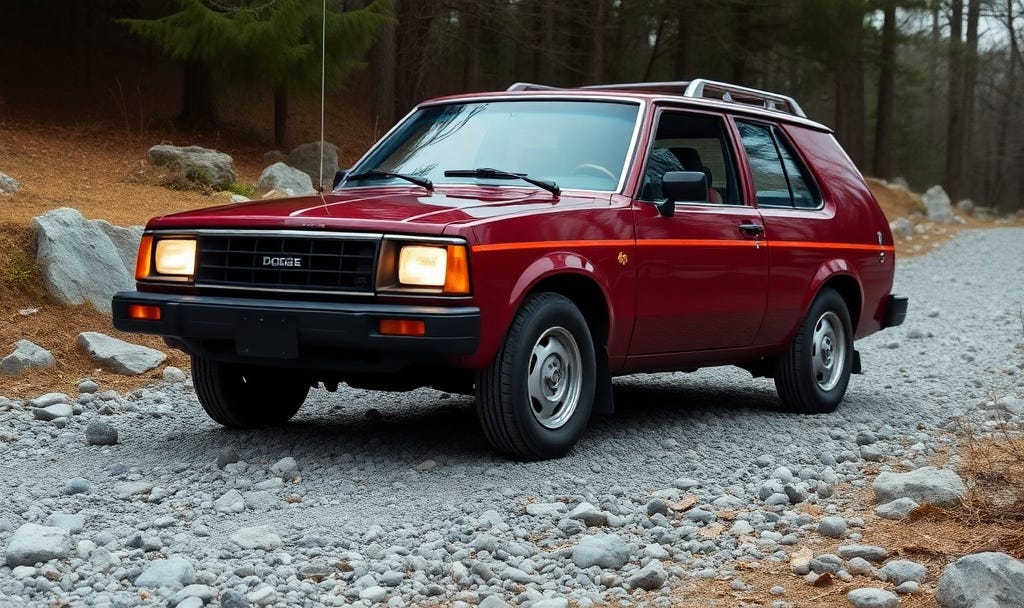
My Dodge Omni waddled side to side on the huge rocks of the lane. All these years later and Granpa still hadn’t dumped smaller stones over the ankle-breaking rocks to smooth our drive. As the car thumped past the creek, into the trees, darkness descended. I could see lights on in Granpa’s house at the right and in Aunt Char’s house on the left. My parents’ van was parked at Aunt Char’s, probably to make room for the guests’ cars in Granpa’s driveway. I wasn’t sure if I should park there as well. I didn’t want to trip back in the complete dark, I reasoned.
I parked at Granpa’s, but when I poked my head inside, no one was in the great room. In the gloaming of sunset, I tripped across the stones to Aunt Char and Uncle Maurice’s. Uncle Maurice greeted me with his characteristic overwarmth. He went for a hug, which I maneuvered into a side-arm squeeze. I could see my parents at the kitchen bar, under low lights, but Maurice asked if I wanted a tour. I hadn’t seen the progress on the house, which seemed to be as slow as Granpa’s. Pressboard still showed in Granpa’s open dining room area; bare brick, awaiting a fireplace, drew the eye in Char and Maurice’s living room.
At some point, Mom welcomed me into the nook, where Dad, along with Mom’s oldest sister, Susan, and her husband, Kay, sat on stools. An energy buzzed in the room, as if I’d interrupted an important conversation. I took the measure of it, and though I needed to practice the song, I stuck around long enough to find a little of what Char and Susan thought of Honoré. She and her family were gypsies and gold diggers. Dad surmised that Granpa had fifty grand in tools alone, and what with Granpa, they could settle in and make good use of those. I wondered if Dad and Maurice had hoped to inherit a few of those someday.
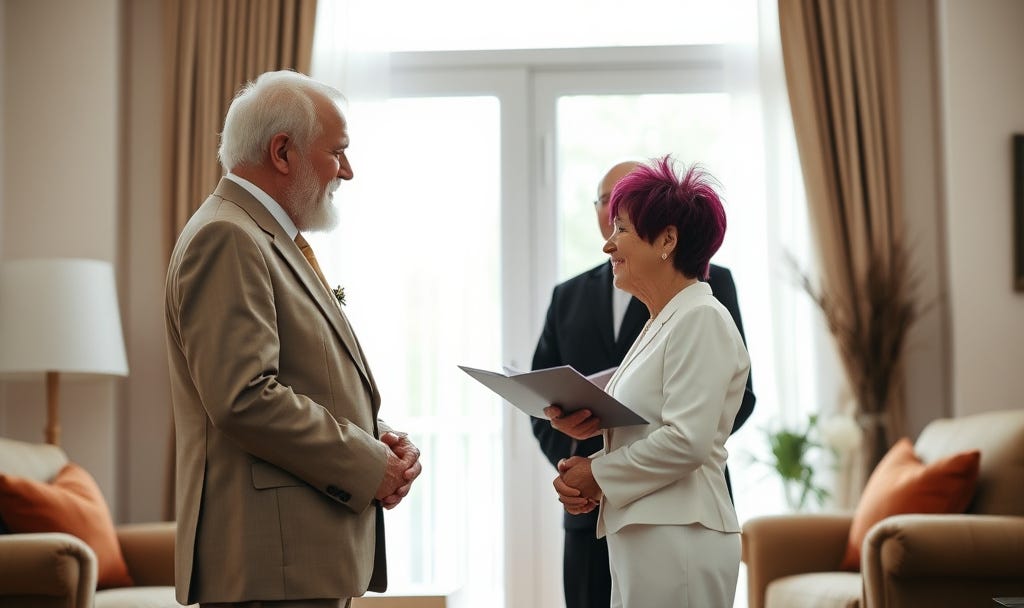
I’d briefly met Honoré, with her spiky, old-lady hair dyed aubergine and her metallic lamé tracksuits. She had cheap tastes, but more dressed up than Granma in the years since we’d begun building. Granma’s sweatshirts and matching pants were plain and clean. Nothing fancy. She hardly put on rings or earrings after the move. And she’d been a classy lady when she was a beautician.
I entered Granpa’s house through the back door. The chairs, padded with bright orange vinyl, clashed with the rose carpet and drapes Granma bought. Honoré had left those, but taken out the Ethan Allen furniture and lamps, replacing them with gilded bisque porcelain lamp bases. The room was going for Baroque, I wanted to joke. But not to Granpa.
Granpa was in the great room this time, looking sporting in his white polyester suit. He called Michaela up from the basement and gave us the guest bedroom to practice. I plugged in my cheap boombox and hit play on I Swear, which I’d recorded off of our local radio station. I’d transcribed the lyrics. I wasn’t giving the band a lick of my hard-earned money. Michaela and I managed to ease our nerves, but my voice still warbled. She could sing quite well, it turned out. I flailed through the notes, feeling my Irish nose, nostrils flaring and large pores flushing florid, and my pulse racing betrayed my anxiety. Michaela carried the performance, though I couldn’t hear her over my anxiety. When finally it was over, I melted into one of the orange chairs. Honoré and Granpa clasped hands. Uncle Bruce stood before the windows black with night and read the text from his folder. When he came to, “If anyone objects to this union, let them speak now or forever hold their peace,” Aunt Char stood up.
“I object.” Her face was tight, like Mom’s when we’d pushed her last button, plucked her last string.
“On what grounds?” The words stumbled out of Uncle Bruce’s mouth. Clearly, he didn’t have a playbook for this.
Granpa first registered shock. I don’t know what Honoré’s expression was. Her back was to me.
I can’t recall if Char outright said or merely insinuated, “My father cheated on my mom” before she sputtered to silence.
“Are you finished?” Uncle Bruce asked. Perhaps he failed by giving her the floor for so long. He was flustered and red-faced.
I can’t remember if she sat down or “excuse me’d” her way out of the middle of the row after saying yes. But she left.
Bruce cleared his throat. “Okay. Let’s move on.”
“They don’t train you for that in seminary,” he told Dad after the ceremony.
Months later, after Granpa told Char and Susan he disowned them, then told Mom and Joann they were no longer welcome at his house or to call him, I asked Mom if she knew that Char was going to object. She had an idea something was going to happen after listening to Susan and Char just before the ceremony, “but not that,” she replied. And Joann had no idea. Susan and Char thought Joann was too much of a daddy’s girl, even at forty, to bring her into the inner circle. Joann would go along to get along with Granpa, and honestly, so would Mom.
Being disallowed from talking to her dad evoked more sorrow in Mom than I’d seen in years. I asked her about it because sometimes Joann cried at work, and then she and Dwayne sold their five-acre parcel. Granpa had already decided Mom and Dad’s decision to follow his stable job to Illinois was a betrayal of loyalty. They’d sold their parcel and the house we’d built. Now, Joann had the chance to live in the kind of house I knew she admired. And she could move away from the daily drive past Granpa’s house. I started thinking of her as Cordelia, trying to please King Lear with sincerity. I took the analogy too far, though, wondering if Char was Goneril, Susan was Regan, and if my mom was another Cordelia or a Regan. Joann had first tried bringing Granpa and Honoré pizzas as a peace offering. Eventually, she persuaded Granpa to talk to her, and by the time David and I married, his cold anger had warmed enough for him and Honoré to attend my wedding.
In the years that followed, I thanked God and often told David, “At least my dad’s side of the family is more forgiving, more gracious. They have fun together, as my siblings and I do.” I couldn’t imagine such a fracturing in my family. Many of them were my closest friends, and the ones I didn’t know as well? I admired them.
I’m so sorry for this song on the playlist. I truly hate it. Still.
Family can be so easily fractured. We can only hope the repairs can be done prior to eternity.